October 2014
The last general election in 2010 was dubbed the first social media election, however, just a simple Google search gives you contradictory results.
“It’s about face to face now, it’s not about putting pieces of paper through people’s doors”, says Terry Stacy, the Liberal Democrats prospective parliamentary candidate for Islington South and Finsbury.
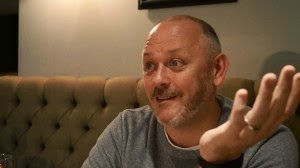
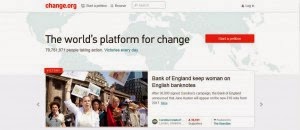
“This election is where social media has actually become quite important. Whether it’s Facebook, Twitter, whether it’s email generally, and we have a whole new generation of voters who use social media every day to show their support for a particular campaign. I think the change.org website to sign petition is a good example of that.”
But how are the political parties in Islington dealing with the social media revolution? Let’s start with the Conservatives. They haven’t had a member of parliament in Islington since 1931, which makes it unlikely that the party would put any effort into reclaiming the borough. This lack of effort comes through online. When you happen to pass through the website dedicated to the two candidates in the 2010 election (which is still available for some reason), you feel like you’ve travelled back into the 1990s or at least the early 2000s.
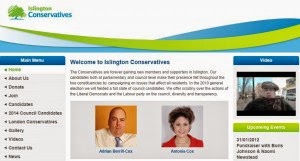
Sure, website design might not be priority number one in local politics (or uploading pictures to Twitter while making sure everyone in the picture hasn’t been decapitated).

But when politicians and journalists’ start using the term “THE ELECTION STARTS NOW!!!” what you don’t want to see is a website where the most recent upcoming event was a fundraiser with Boris Johnson in 2012. The couple behind the website, Antonia Cox and Adrian Berrill-Cox, were the conservative candidates for Islington South and Finsbury and Islington North in the 2010 parliamentary election. Together they scraped 14 788 of the 88413 votes cast – barely 17 percent.
The whole thing is a bit confusing. Unless you do more thorough research, you might think that The Islington Conservatives have given up after the abysmal results in 2010. However, if your attention span is longer than 30 seconds, you realize that the Islington Conservatives are looking forward with a new website.

Islington is a Labour stronghold, with the Liberal Democrats squeezing themselves in once in a while. In the local elections earlier this year, the Liberal Democrats lost all eleven of their councillors, Terry Stacy being one of them, leaving the council with 47 Labour members and a single Green councillor. While the Islington Conservatives seem to be on standby, the others are pushing forward.

On the surface, the Conservatives doesn’t seem to promote anything constructive. Adrian Berrill-Cox encapsulates this: “just because it’s good doesn’t mean it can’t be better”.
When you enter the other sites for the major parties you are bombarded with actual suggestions like “Cleaner Greener Buses for Islington Now”, while the Lib Dems has chosen to focus on libraries…
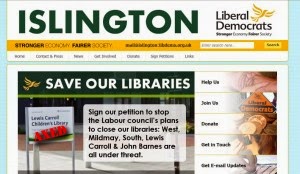
… And then we have the Greens who have chosen simplicity over complexity and just gone with a load of awkwardly smiling people.

They’ve got one councillor – it obviously works.
If you look at the different social media profiles of the probable candidates for Islington this May, it becomes clear who the king of the concrete jungle is. Jeremy Corbyn has been the MP for Islington North since 1983.
Here he is discussing the 1992 general election.

Back then he had already been an MP for NINE YEARS. He’s considered to be one of the most leftist Labour MPs in the House of Commons. On the first page of YouTube results when you search ‘Jeremy Corbyn’ you get results like “Lefties happy to hand over Falklands to Argentina” and ‘Jeremy Corbyn MP on Palestine’ featured on the Communist Party channel.

His more than leftist stance may have kept him from rising within the party, however, it hasn’t stopped him from achieving 22 900 followers on Twitter. Trailing by 10 000 followers is his Labour colleague in Islington South and Finsbury, Emily Thornberry, the shadow attorney general. Some might argue that Twitter inadvertently shows their true colours (or at least who’s more of a “red Ed”).
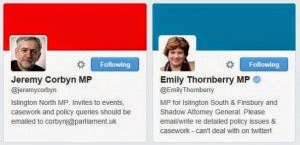
Corbyn’s prowess in social media and prevalence on YouTube might be because of his willingness to depart from party policies and say what he actually thinks. Whether it’s laying it out on Palestine, or going against his own party leader and speaking against bombing ISIS.
In the last election, Corbyn got 24 276 votes. Technically, that could be 93 percent of his voter base. By that standard, David Cameron should have 9 975 751.02 Twitter followers…
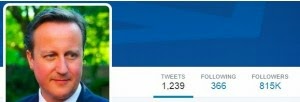
…He doesn’t. And Jeremy Corbyn actually writes his own tweets…
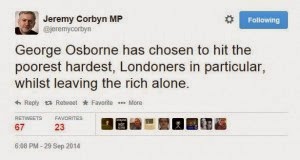
… I assume.
Labour seems really keen for you to talk to them. They seem to like public participation.
But if you want to find more information about your elected representatives you might find that…
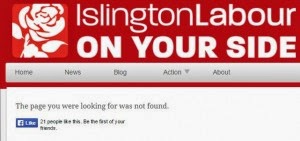
…you can’t actually find them. And apparently, 21 people like it that way.
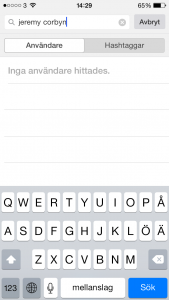
But they do exist, just not on Instagram. And if social media is so important, why are they not taking advantage of it? The White House, Barack Obama, Michelle Obama and Pete Souza (White House photographer) have all got their own, heavily managed, accounts. But Jeremy Corbyn simply doesn’t exist.
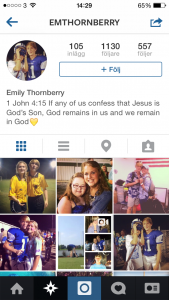
And the closest thing to Emily Thornberry seems to be some girl who’s way too into God and American football players.
Someone who’s really grasped Instagram is former Australian Prime Minister Kevin Rudd.
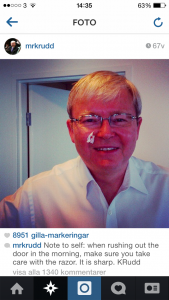
Although he hasn’t posted anything since he lost the election a year ago…
Like teenagers tired of their parents using it, politicians are leaving Facebook in droves. Or maybe they simply never started using it until it was too late. Emily Thornberry’s page can only be accessed if you become her “friend” and the last update on Jeremy Corbyn’s Facebook page is from 27th November 2013. With 6 251 Facebook likes but almost 23 000 followers on Twitter, it’s obvious where the social media status now lies. With a focus on Twitter, it’s the only thing they’re bothering to keep up with, while Facebook, Instagram and various party websites get coated in metaphorical dust.
 Gustaf Kilander